Image Credit: Cuyama Buckhorn
Two hours from Los Angeles and a world away from everything else.
Drop into Cuyama Valley on Route 33 and something happens. The road narrows, the mountains close in, and whatever you packed alongside your luggage — the calendar, the noise, the low hum of the city — begins to loosen. Ferial Sadeghian, who co-owns The Buckhorn with Jeff Vance, has watched it happen in guest after guest. “There’s a feeling you get when you get away from the city and find the peace and quiet of the desert,” she says. “A two-hour drive that, when you drop into the valley, clears all thoughts and tensions.”
Vance has known this feeling his whole life, having grown up riding motorcycles through the valley with his father. When The Buckhorn came up for sale in 2018, the pull was instinctive. They drove up, walked the property, and, as Sadeghian puts it, “immediately imagined restoring the motel to its glory days.”

Image Credit: Cuyama Buckhorn
The Bones of the Buckhorn
In 1952, the Richfield Oil Corporation commissioned notable mid-century architect George Vernon Russell, the same mind behind the Flamingo Hotel in Las Vegas, to build the Cuyama Buckhorn. When Sadeghian and Vance took over 74 years later, the bones were still there.
History informed every step of the renovation. Furniture was built from oil pipes and salvaged wood siding found on the property, materials that carried the valley’s own shift from oil fields to ranches and farms within them.
The result is a property that resists the mood-board version of itself. Sadeghian is clear-eyed about the market, acknowledging that mid-century design and American West references are everywhere right now, but at Cuyama Buckhorn, she says:
“It’ll never go out of style. It’s just the soul of the place.”
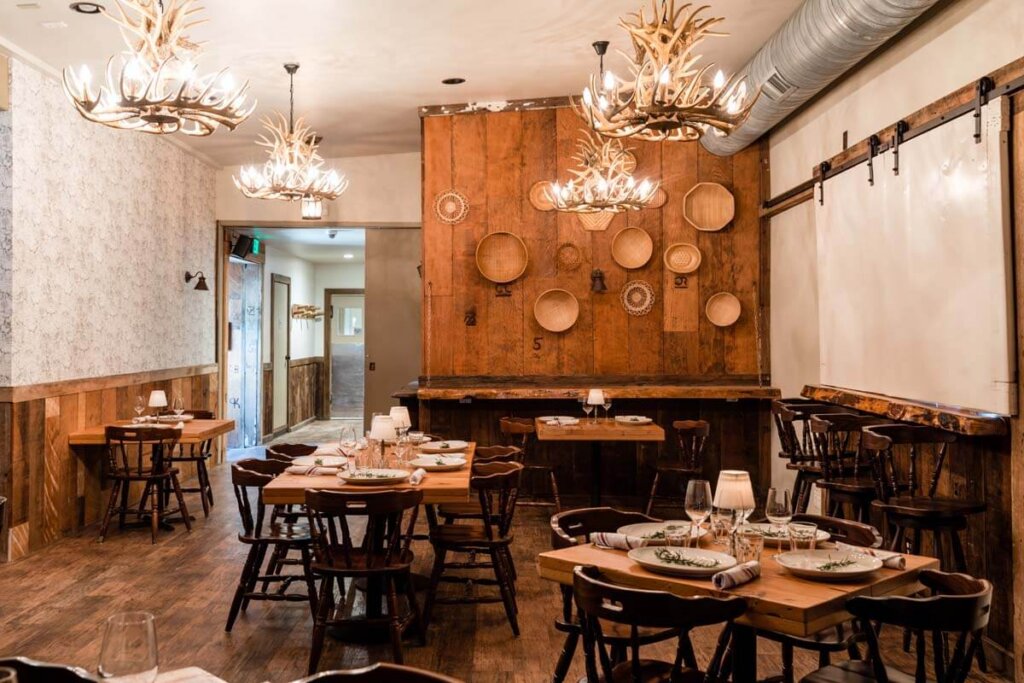
Image Credit: Cuyama Buckhorn
Rooted in the Land
Sadeghian holds a master’s in architecture and grew up the daughter of an Iranian diplomat, traveling frequently through Europe. She arrived at hospitality with two governing passions: buildings and food. In her childhood home, food was treated as something close to sacred. “I thought every home-made food from scratch,” she says, “and every mother negotiates with her local grocer to get the freshest delivery of fruit and hand-picks each one.” Those standards followed her everywhere she traveled and shaped what she eventually wanted to create.
What troubled her about American road trips was the absence of any honest meal along the way. Cuyama Buckhorn sits directly off Route 33 with nothing else close by, and rather than treat that as a limitation, she saw it as a responsibility. The restaurant works with local ranchers, neighboring vineyards, and the organic dry-farmed producers at Condor’s Hope Vineyard. The on-site market carries valley wine, local honey, jujubes, eggs, and cheese from nearby farms, creating what Sadeghian describes as a full economic cycle, closed and self-sustaining.
Those relationships were built the slow way, one farm visit at a time, beginning with a farmers and ranchers dinner hosted by the Blue Sky Center shortly after they arrived, the first event of its kind the valley had ever held. “The farmers and ranchers are too busy tending to their land or herding cattle to spend their time with neighbors,” Sadeghian says, “so it was a very special night for everyone.”
Not everything they discovered was easy. The valley’s water crisis, driven by VC-backed corporate farming, remains an open wound in the community. “It’s an ongoing issue affecting the community, and it’s heartbreaking.” Using the platform of The Buckhorn to raise awareness, she says, is part of what it means to belong here.

Image Credit: Cuyama Buckhorn
The People Are the Place
Ask Sadeghian what makes a stay at Cuyama Buckhorn truly memorable, and she doesn’t reach for the design or the landscape first. “What makes a place memorable is when it’s truly rooted in a sense of place,” she says, “when you visit somewhere, and it couldn’t exist anywhere else.” The memories, she adds, come from the real interactions, from the people you meet. Most of the staff grew up in Cuyama, many from families with generations in the valley, and their pride in The Buckhorn is not performed. “They genuinely love to share their home with the people who come to visit.” Guests feel the difference. Time and again, Sadeghian hears that the highlight of someone’s stay was a conversation struck up at the bar with someone who actually grew up here, who knew the valley the way only a life lived in it can.
That exchange between place and curious visitor is what Sadeghian set out to protect when she and Vance first came to the community. Before anything else, they spent weeks in collaborative sessions with twenty-five local residents, defining what they wanted the future of Cuyama to look like and, equally, what they didn’t.
That commitment shows up in the details. For Sadeghian, the question of sustainability and the question of community are the same:
“We’ve always wanted Cuyama Buckhorn to be an addition to the community, not a disruption.”
Image Credit: Cuyama Buckhorn
Every Season, Something
The valley gives differently depending on when you arrive. “In the summer, sunsets are magical, and in the winter, after it rains, we get a full array of rainbows,” Sadeghian says. Autumn turns the desert plants and bushes every shade of gold to brown, the color appearing where visitors don’t expect it, on scrub and brush rather than trees. Spring brings the wildflower bloom at Carrizo Plain National Monument, reason enough for a trip on its own. “The magic of Cuyama,” she says simply, “is in getting into the landscape.”
For first-timers with a single night, Sadeghian’s instructions are specific. The sunset from The Vista, the terrace behind the pool, is non-negotiable — “the painted sky and the silhouette of the mountains” stopping conversation every time. Afterwards, the Tea Room: a self-serve honor bar of loose leaf blends she designed as a quiet ritual before sleep. “I’ve loved tea my whole life and really believe in its healing properties,” she says. During the day, go out with Sam, the bartender who leads goat hikes through private trails with his pack animals, foraging native plants as he goes.
By checkout, Sadeghian says, guests carry themselves differently:
“More relaxed, more present, sometimes a little sun-kissed.”

Pictured: Ferial Sadeghian